Mastery Chapter 4 - Social Intelligence
Chapter 4: Social Intelligence
Keys to Mastery:
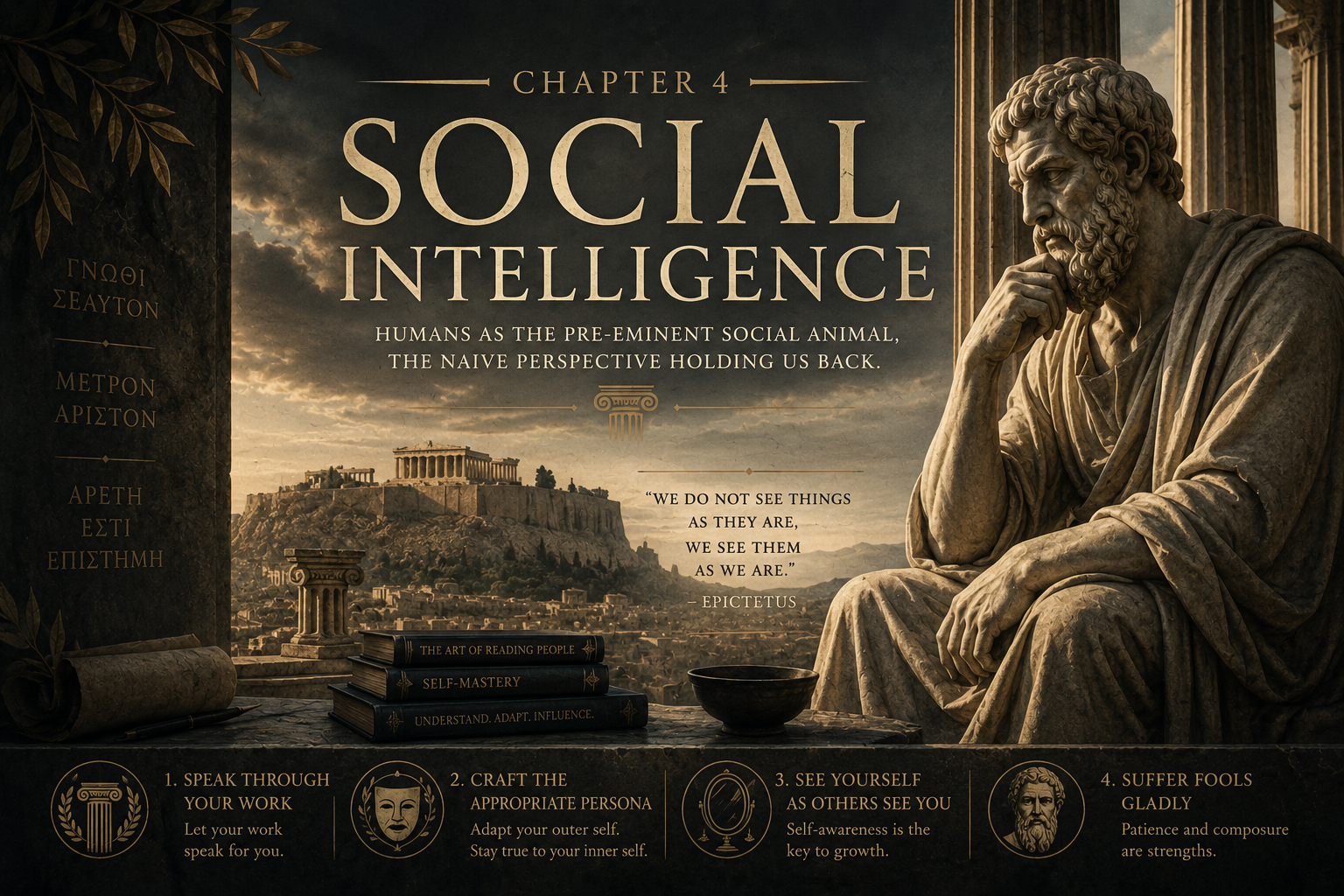
Humans are the pre-eminent social animal. The greatest obstacle to understanding others is the Naive Perspective, where we interpret people through the lens of our own emotions, desires, and expectations instead of seeing them objectively.
Reading People
Mastery requires learning to observe people before judging them.
Non-verbal Communication
- Pay attention to body language and facial expressions.
- Listen to tone, pacing, and hesitation.
- Observe actions more than words.
- Look for common emotional experiences.
- Look for patterns over time.
- Avoid relying on first impressions.
Lesson:
People often reveal their intentions through consistent behavior rather than what they say.
Key Concepts
| Term | Description | Key | Lesson |
|---|---|---|---|
| Naive Perspective | Viewing people through the lens of our emotional needs or as extensions to our desire. | Flawed lens, childish illusions, Emotional churn - we misread intentions to fit our expectations | We must learn to actively recognize if whether we are viewing someone through the lens of our “objective Judgement” or our own “Naive Perspective” |
| 7 Deadly Realities | Inescapable flaws of human nature. Negative qualities of human behaviour | Envy, Conformism, Rigidity, Self-obsessiveness, Laziness, Flightiness, Passive Agreesion | We must learn how to discern 7 deadly realities. |
The Four Strategies for Acquiring Social Intelligence
1. Speak Through Your Work
Let your work communicate your ability instead of seeking constant recognition or validation.
- Focus on producing meaningful work.
- Avoid arguing about your competence.
- Build credibility through consistent results.
- Let accomplishments speak louder than words.
Lesson:
Respect is earned through work, not self-promotion.
2. Craft the Appropriate Persona
Adapt your outward behavior without changing your values.
- Understand the culture and environment.
- Present yourself in a way others can receive.
- Develop emotional control.
- Be approachable without becoming inauthentic.
Lesson:
Social intelligence is knowing how to present yourself without pretending to be someone else.
3. See Yourself as Others See You
Develop self-awareness by understanding how your actions affect other people.
- Accept constructive criticism.
- Observe how people respond to you.
- Identify blind spots.
- Separate your intentions from your actual impact.
Lesson:
Your self-image is often different from how others experience you.
4. Suffer Fools Gladly
Learn patience when dealing with difficult or irrational people.
- Do not react emotionally.
- Stay calm under provocation.
- Learn from every interaction.
- Focus on long-term objectives instead of winning arguments.
Lesson:
Emotional control is a competitive advantage. The master remains composed while others lose control.
Reflection
Social intelligence is not manipulation.
It is the ability to understand people objectively while managing your own emotions. According to Robert Greene, mastery depends as much on reading people as it does on technical skill. The more accurately you perceive others and yourself, the more effectively you can learn, collaborate, and lead.